Where the case stands
The building’s identity, location, and function remain unresolved.
Basis for this status: The photograph and available comparisons have yet to yield a named match. The Library’s title suggests a theater; a reader has suggested a church. The photographers’ history also raises a question about the supplied date.
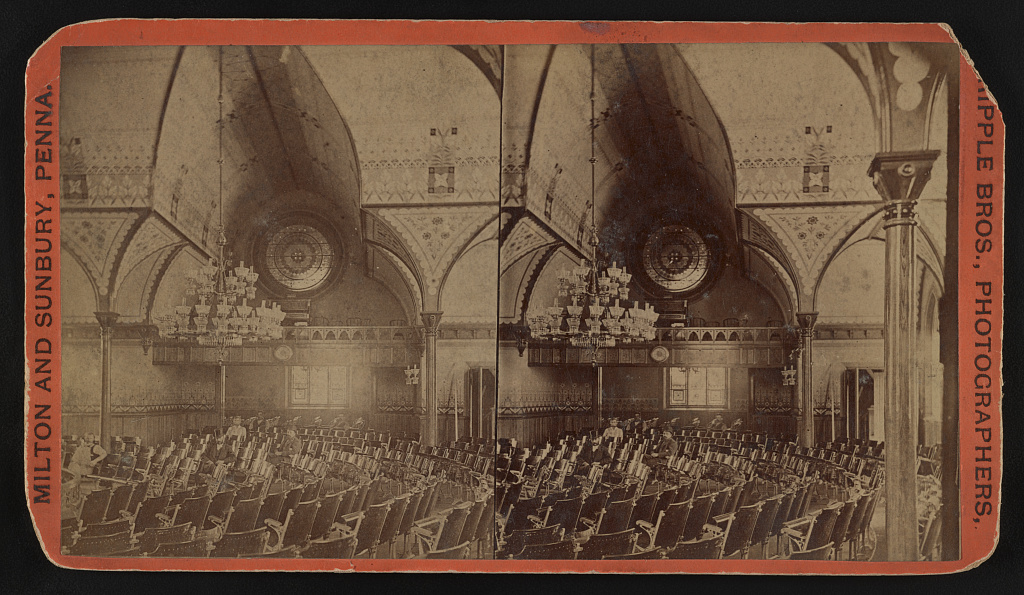
An enormous chandelier hangs beneath pointed arches. Below it, rows of separate seats face beyond the edge of the photograph. Someone could have sat here for a performance, a lecture or a service; the part of the room that might settle the question lies outside the frame.
The Library of Congress files it under [Theater], with an attribution to Ripple Bros. and a date of [1864] in its official Flickr description. Library staff devised the title, so we begin with their suggestion of what the room might be rather than a name supplied by its photographer.
The mount gives the photographers’ studio locations as Milton and Sunbury, Pennsylvania. Those addresses offer a place to begin looking for the room, though the brothers could have sold views made elsewhere.
Reading the room
Tall columns carry pointed arches beneath a decorated ceiling. A gallery-like balustrade runs above the side wall, and a large circular feature sits high on the far wall. Its material and design are difficult to make out in the web image.
A labelled second view showing that circular feature, the columns and the gallery together would be especially useful. The chandelier catches the eye, but a light fitting could be moved or replaced; the architecture should be easier to follow across photographs taken years apart.
Individual seats stand in rows divided by aisles, with details that suggest folding construction. They obscure much of the floor, making its slope hard to judge. A view in the direction the seats face might reveal a stage, an altar or another arrangement entirely.
Theater, meeting hall, church?
The rows of seats fit the Library’s suggestion of a theater, but a church or lecture hall could have used much the same furniture. We need to find this arrangement in a photograph, plan or description that gives the room a name.
On the Flickr post, reader swanq questions the apparent floor arrangement and suggests an Eastern Orthodox church. The comment puts a worship interior into the discussion, though it names no particular church to compare with the photograph.
An assembly or lecture hall is another possibility. The room might also have changed use, which would make the date of a proposed match as useful as its caption.
Following Ripple Bros.
The imprint raises a question about [1864]. Herbert C. Bell’s 1891 history of Northumberland County describes photographer Conrad Rippel, born in 1854, taking up photography at twenty. In 1878 he moved from Muncy to Milton and traded as Rippel Brothers; after the fire of 1880, he settled in Sunbury.
If the card’s “Ripple Bros.” is this firm, as the two towns and profession suggest, its history is hard to reconcile with an 1864 production date for the mounted print. An older negative could have been printed later, so the history of the studio may help date the card without yet dating the room as photographed.
Dated advertisements and other labelled Ripple Bros. cards could help narrow that interval and show which places the firm photographed. A series title or number on another card might also connect this interior to a wider set of views.
Can you place it?
The best lead would be another labelled view of this interior. Look for the circular wall feature, the columns and the gallery together. Send a repository link or item reference, with the features you think match.
Other useful pieces would be:
- A plan or contemporary description matching the column spacing, aisles and gallery. Include the publication, date and page, or archive reference.
- A dated Ripple Bros. advertisement, directory entry or labelled card that helps document the photographers’ work.
- Information from the original card or its reverse. A note, number or series title there could redirect the search; we have yet to inspect the back.
The research notes hold the fuller source trail and the comparisons still to be made.
Sources and credit
- LOC Flickr post: Library-authored title, attribution, date, collection, rights statement and public discussion, checked October 20, 2026.
- LOC digital resource and persistent identifier.
- swanq’s comment, credited as an uncorroborated hypothesis.
- Photographers’ history: Herbert C. Bell, ed., History of Northumberland County, Pennsylvania (1891), pp. 859–860. Both printed pages were inspected; the Ripple/Rippel connection remains a proposed link.
- Photograph: Ripple Bros.; Library of Congress, Marian S. Carson Collection, LOT 13696, no. 14. The Library states “No known restrictions on publication.” The complete web JPEG is shown without generated enhancement.

Research update
October 20, 2026: Bell’s printed biography adds a dating question: if Ripple Bros. was the Rippel Brothers firm he describes, the mounted print may be later than LOC’s supplied [1864]. An older negative could still have been printed later. The room remains unidentified, and no replacement exposure date has been established.
A clue to add?
A named source, a dated plan, another view: small pieces can change the picture.
Contribute evidence